Strategic Planning Retreats
Creating strategy that’s grounded in community and built for action
Strategic planning is often treated as an internal exercise – something that happens in a room with a board or leadership team and results in a document.
At Tilia Consulting, we see it as something more meaningful (and more useful): a participatory, strengths-based process that helps people build shared direction, make clear choices, and leave with a plan they’re actually ready to use.
Strategic planning retreats are especially valuable when organizations are:
navigating growth, transition, or increased complexity
reassessing their role, relevance, or long-term direction
feeling pulled in too many directions at once
seeking stronger alignment between governance and operations
wanting strategy that reflects lived experience, not assumptions
ready to move past “that’s the way we’ve always done things” and imagine what’s next
A strengths-based, participatory approach to strategy
Our strategic planning retreats are grounded in an appreciative, strengths-based philosophy informed by Transformational Strategy (Technology of Participation) and the SOAR framework.
At the heart of this approach is a simple belief:
positive questions lead to positive change
strategy is most effective when it’s co-created
people are more likely to implement what they help shape
Rather than starting from what’s broken, we focus on:
strengths and assets already present
opportunities for growth and innovation
shared aspirations for the future
the results and impact you want to create
This doesn't mean we avoid the hard stuff. We spend real time with challenges, constraints, and trade-offs – but always in service of forward movement, clarity, and possibility.
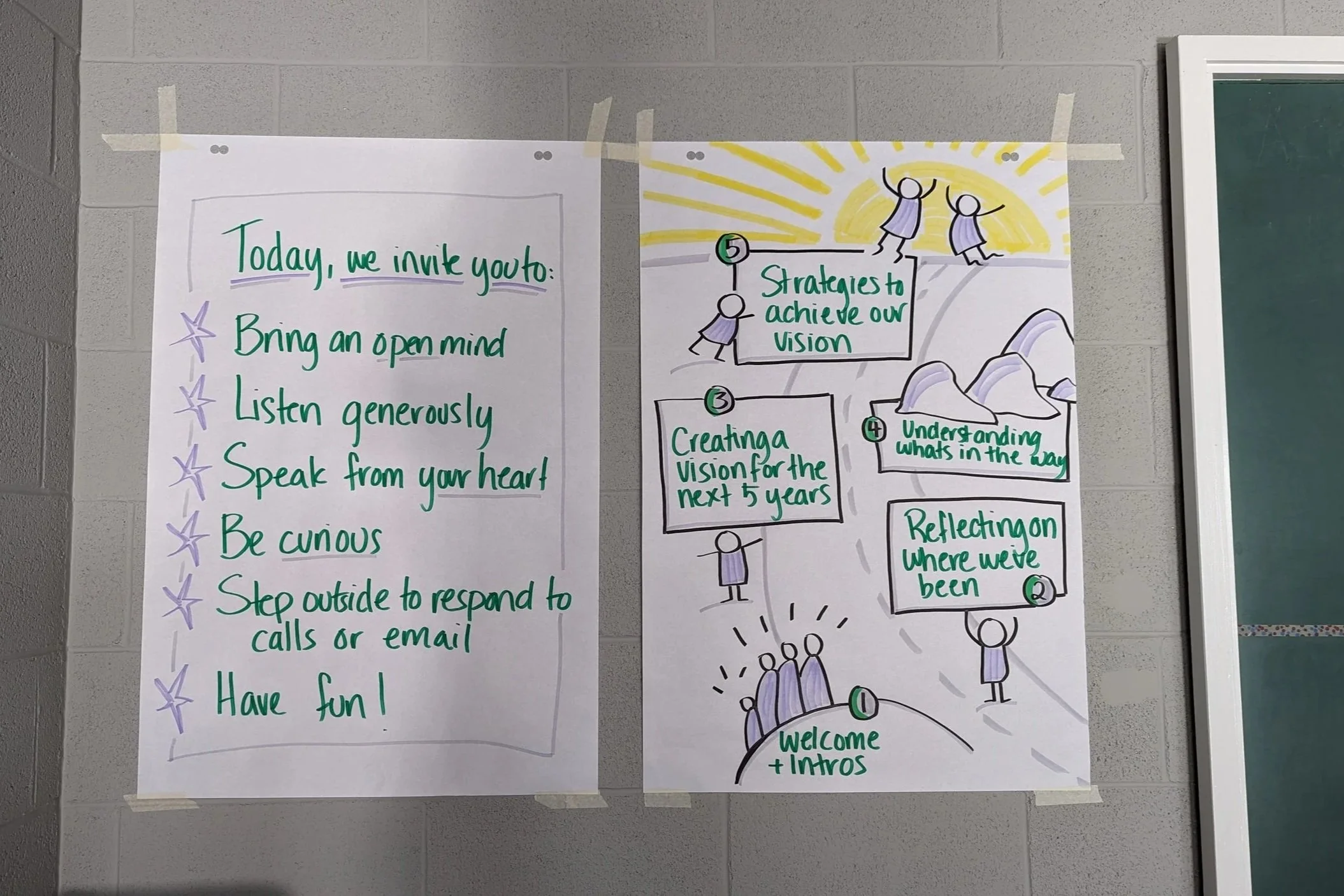
Setting shared intentions and a clear flow at the start of a strategic planning retreat helps people slow down, listen well, and focus their attention on what matters most.
Designing for contribution and shared ownership
In our experience, the wisdom needed to move forward is usually already in the room. Our role is to create the conditions where that wisdom can be surfaced, explored, and translated into clear direction.
We structure conversations so people can contribute in ways that work for them (blending individual reflection, small-group dialogue, and large-group sense-making) while keeping the group moving toward clear outcomes.
We also approach facilitation as a relational practice. People bring history, emotion, and lived experience into every conversation, and those dynamics shape how decisions are made. Paying attention to how people are relating (where energy or tension is present, and what’s needed to move the conversation forward in a good way) is just as important as the content itself.
This approach helps ensure strategy doesn’t live only in a document. It lives in the people responsible for carrying it forward.
Grounding strategy in lived experience (inside and beyond the organization)
For many organizations (especially municipalities, nonprofits, foundations, and membership-based groups) strategy needs to be informed by more than internal perspective. It needs to reflect the lived experience of the people most connected to the work.
That’s where Tilia’s community and public engagement background becomes a strategic planning advantage.
We design strategic planning retreats that are informed not only by the people making decisions, but also by the people those decisions affect. Depending on context, timing, and capacity, this may include a listening phase that gathers insight from:
the people you serve (or residents and taxpayers, in a municipal context)
staff and volunteers
partners, funders, donors, and community members
This input might be gathered through a short survey, informal conversations, facilitated listening sessions, hosted community conversations, or other approachable methods that feel neighbourly rather than transactional.
When groups come together to make strategic choices, they do so with a clearer understanding of what’s happening beyond the table – grounding decisions in real experience rather than assumptions.
Want a deeper look at how we design community-centred strategy processes – and how to right-size engagement based on your budget, capacity, and context? Check out this post: A Community-Centred Approach to Strategic Planning (link coming soon).
What a strategic planning retreat is designed to do
A strategic planning retreat is about more than producing a plan. It’s about creating the conditions for people to think clearly together about the future – and to leave feeling oriented, aligned, and ready to move forward.
When we design strategic planning retreats, we pay close attention to both:
what gets clarified and decided together in the room, and
how people leave feeling about the direction, the work ahead, and their role in it.
Those two things are deeply connected. When people feel grounded, heard, and part of the process, strategy stops feeling abstract or imposed – and starts to feel usable, credible, and shared.

Strategic thinking doesn’t all happen through talking. Thoughtful materials invite reflection, creativity, and different ways of engaging with complex questions.
What you can expect to walk out with
Every strategic planning retreat we facilitate is customized to the group and context. Typically, these retreats support both clear direction and collective momentum.
In terms of direction, groups often leave with:
a clear short- to medium-term vision (often looking 3–5 years ahead)
a small number of strategic directions or priorities that guide decision-making
a shared understanding of barriers, constraints, and trade-offs
decisions that are documented clearly enough to use between meetings
Just as importantly, groups often leave with:
increased alignment and confidence in the path forward
deeper shared understanding across governance, leadership, and operations
a sense of shared ownership – people see themselves reflected in the direction
renewed energy, imagination, and a feeling of “we can do this”
When clarity and momentum are aligned, strategic plans are far more likely to be used (and less likely to collect dust on a shelf in a backroom).
A note on implementation: strategy is not the finish line
We’re on a mission to eradicate “strategic plan on the shelf” syndrome.
That’s why we often build in a clear bridge from strategy into action – through implementation-ready deliverables, a validation checkpoint, or a dedicated action planning session (more on that in the next post in this series).
We regularly support organizations in:
translating strategy into action planning
validating strategic directions with external audiences
communicating the strategy in accessible, meaningful ways
checking back in with communities as implementation unfolds
This creates a feedback loop that strengthens accountability, learning, and long-term impact.
Planning a strategic planning retreat?
Our first step is always a conversation about your context: what you need to achieve, how you want people to experience the process, and whose voices need to inform the work. From there, we design a process that is strengths-based, participatory, and built for your decision-making context.
Next in the series: Action Planning Retreats – turning strategic direction into momentum.