Board & Council Retreats
Orientation, alignment & better governance conversations
Boards and councils play a critical role in setting direction, stewarding mission, and ensuring accountability – often while juggling limited time, complex information, and significant responsibility. And yet, much of that work happens in regular meetings focused on reports, approvals, and immediate issues, with very little space to step back and look at the bigger picture.
A well-designed board retreat creates that space.
At Tilia Consulting, we work with governance boards, operational boards, and municipal councils at key moments of transition and decision-making – helping groups build shared understanding, clarify their role, and strengthen how they work together in service of good governance.
When a board retreat is especially useful
Board retreats are particularly valuable when:
new members are joining and need orientation to strategy, context or history
the organization or community is entering a new phase of work or facing increased complexity
there’s confusion or tension between governance and operational roles
the board or council wants to revisit priorities or strengthen how it works together
In these moments, a retreat offers more than extra meeting time – it offers a chance to reset how the group understands its role, responsibilities and impact.
We’ve supported board and council retreats for organizations at very different moments in their journey – from service-based organizations navigating growth and complexity, to community-based nonprofits and public bodies clarifying roles, onboarding new members, or resetting how governance happens in practice.
In each case, the specifics were different. The underlying need was the same: space to step back, build shared understanding, and strengthen how decisions are made together.
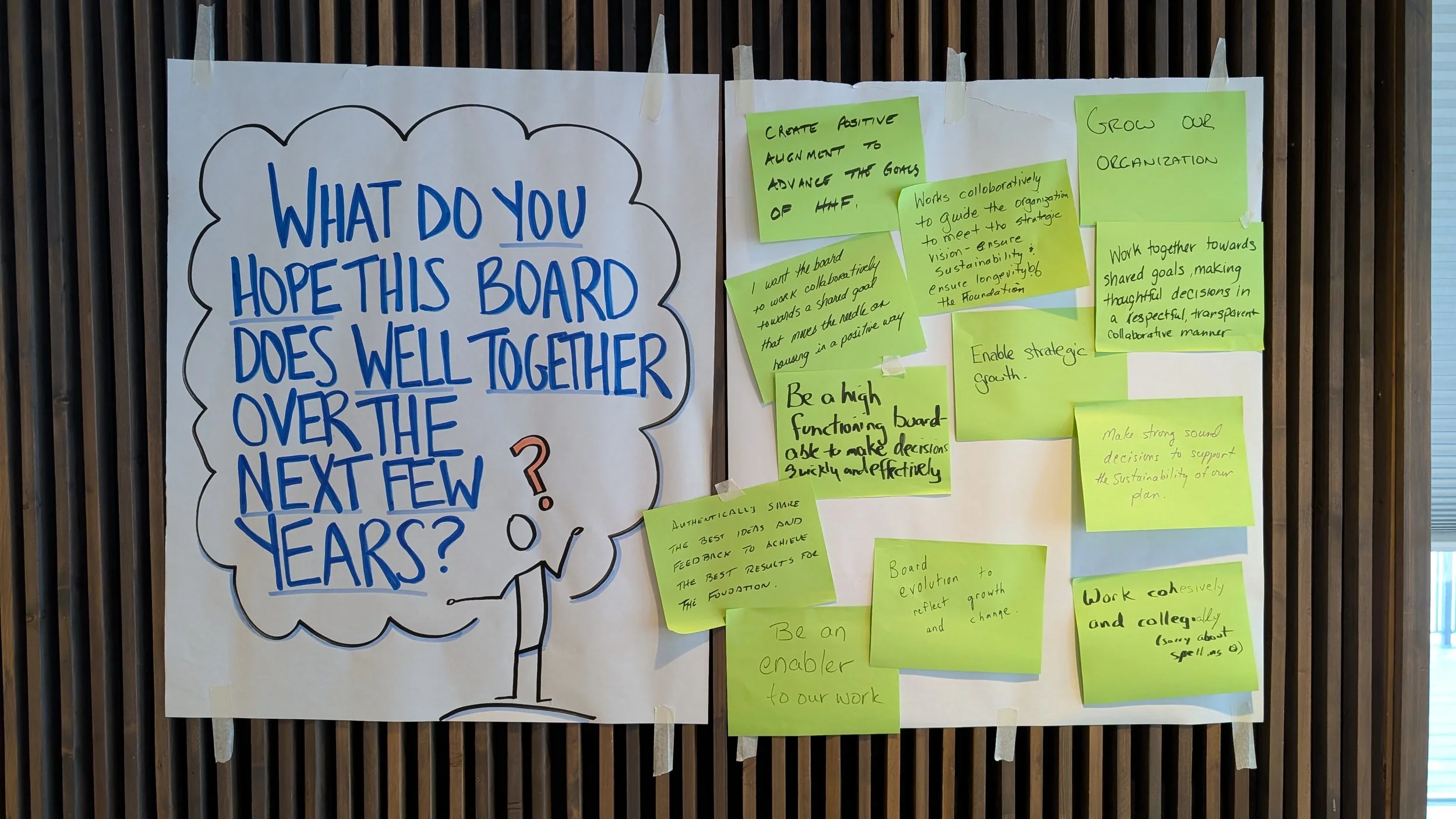
Board retreats create space for boards and councils to step back, reflect together, and articulate what good governance looks like in practice.
What board retreats are actually for
While every board or council is different, most retreats are ultimately about helping people govern well – not just efficiently. In practice, that often means creating space to focus on a few core areas that are difficult to address in regular meetings:
Shared context and orientation – ensuring everyone is working from the same understanding of mission, strategy, operating environment, and constraints.
Role clarity – clarifying roles, responsibilities, and decision-making boundaries, including the relationship between governance and operations.
Strategic alignment – building a shared view of priorities, risks, and opportunities so discussions are grounded in purpose rather than individual assumptions.
Stronger board dynamics – developing shared language and practices that support productive engagement when things are complex or uncertain.
Designed to support intentional outcomes
When we design board retreats, we pay close attention to both what gets created together in the room and how people leave feeling, relating, and working differently as a result. As with much of our work, board retreats are intentionally designed to create both clarity and confidence.
Clarity often shows up as:
clearer roles and decision boundaries
shared priorities and areas of focus
more effective committee or decision processes
clearer guidance for staff, administration, or leadership on key questions
Confidence shows up in how the board works together:
members feel more grounded in their role
conversations are more focused and less reactive
differences can be explored without things getting stuck
trust and shared responsibility are strengthened
When these two are aligned, boards and councils are better equipped to govern well between meetings – not just during them.
Many people come into retreats carrying a mix of responsibility and uncertainty – wanting to do the right thing, but not always sure where governance ends and operations begin, or how to raise hard questions without creating friction. A well-facilitated retreat creates space for those questions to be explored openly, constructively, and with care.
Where retreats often get stuck
Many boards and councils come into retreats with good intentions, and still leave feeling that the time didn’t quite land.
Over the years, we’ve seen retreats lose momentum when:
the agenda is packed with updates and presentations, leaving little room for dialogue
expectations about what the retreat is meant to accomplish are unclear
governance and operational roles are assumed rather than explicitly discussed
the process doesn’t match the group’s level of trust, experience, or history
When this happens, retreats can feel busy without being useful – or productive in the moment, but disconnected from how the group actually works afterward.
How we design board retreats differently
Rather than centering retreats around information-sharing, we design them around sense-making and judgment – the core work of good governance.
This means creating processes that:
help groups work with real questions they’re facing now
balance reflection with decision-making, rather than rushing to conclusions
surface different perspectives in ways that strengthen rather than fracture the group
adapt to the group’s maturity, context, and relationships
In practice, this often means fewer presentations and more facilitated conversation – with enough structure to keep the group focused, and enough flexibility to work with complexity as it emerges.
The result is a retreat that supports boards and councils in doing the work only they can do: thinking together, exercising judgment, and stewarding the organization or community with care.
What this makes possible over time
When board retreats are designed this way, the impact extends well beyond the day itself. Groups are more likely to:
bring clearer roles and decision boundaries into regular meetings
engage more constructively when perspectives differ
make decisions with greater shared understanding and confidence
build stronger, more trusting relationships with leadership and administration
navigate complexity without defaulting to reactivity or avoidance
These aren’t just good retreat outcomes; they’re markers of a board or council that’s functioning well over time.
A note on context & confidentiality
Much of our board and council retreat work takes place in confidential settings with foundations, nonprofits and public-sector organizations navigating real and sensitive issues. While examples are available upon request, our focus is always on designing a process that fits your specific context, history and needs.
Planning a board retreat?
Our first step is always a conversation about what your board or council needs to understand, decide, and experience in order to govern well. From there, we design a retreat that supports clarity, contribution, and meaningful progress.